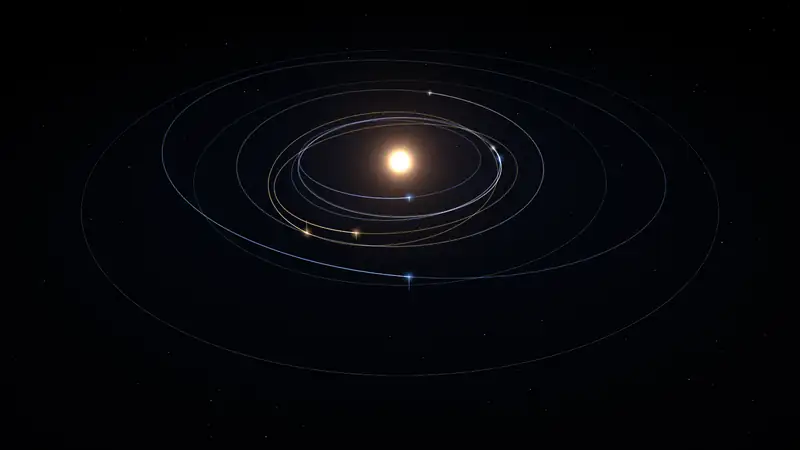
The 3D asteroids: bodies and sources
The view above draws the asteroids that space resource mission records name, around the Sun, at estimated positions for the date shown. These 5 asteroids carry 5 of the 6 asteroid mission records in this dataset. The other names no single asteroid.
Positions change with the date, so the live view computes them. They are not listed here.
Asteroid targets gives NASA/JPL's fuller figures for each one.
Asteroids and how far each record got
5 asteroidsThis page does not estimate how much of any resource an asteroid holds or what it is worth.
| Asteroid | Class | Size | Round trip from Earth (NHATS) | Furthest step | Records |
|---|---|---|---|---|---|
| 99942 Apophis (2004 MN4)Asteroid targetsShow in the view | Near-Earth (Aten group)JPL classes it as potentially hazardous | About 340 m acrossJPL value; source: Brozovic et al., Icarus 300, 115-128 (2018) | 6.0 km/s354-day round trip, lowest-Δv optionFrom NASA's NHATS study, for departures in 2020–2045, computed 17 October 2024. It does not change with the date shown, and it is not any mission's requirement. NHATS assumptions and caveats | Targetedmission aimed at itRing: a record here is not yet launched | Karman+ Mission 1 (High Frontier, Corvus spacecraft)In developmentTarget: Asteroid (99942) Apophis (operator's target since July 2026; the earlier High Frontier description named an uncharacterized near-Earth asteroid)Step: Regolith: targeted |
| 101955 Bennu (1999 RQ36)Asteroid targetsShow in the view | Near-Earth (Apollo group)JPL classes it as potentially hazardous | About 480 m acrossJPL value; source: Daly, M.G., et al., Sci. Adv. 6, eabd3649 (2020) | 7.0 km/s362-day round trip, lowest-Δv optionFrom NASA's NHATS study, for departures in 2020–2045, computed 14 August 2021. It does not change with the date shown, and it is not any mission's requirement. NHATS assumptions and caveats | Sampledmaterial collected, not extractionSolid: every record here has launched or been cancelled | OSIRIS-REx (Origins, Spectral Interpretation, Resource Identification, and Security-Regolith Explorer)Ended · SuccessTarget: Asteroid (101955) BennuStep: Regolith: sampled |
| 269 Justitia (A887 SA)Asteroid targetsShow in the view | Main belt | About 51 km acrossJPL value; source: urn:nasa:pds:neowise_diameters_albedos::2.0[mainbelt] (http://adsabs.harvard.edu/abs/2014ApJ...791..121M) | Not near-Earth, so outside NHATS | Targetedmission aimed at itRing: a record here is not yet launched | Emirates Mission to the Asteroid Belt (EMA) / MBR ExplorerIn developmentTarget: Seven main-belt asteroids; a probe is to separate and descend to the seventh, 269 Justitia (landing year 2034 in the 2023 announcement)Step: Volatiles: targeted |
| 162173 Ryugu (1999 JU3)Asteroid targetsShow in the view | Near-Earth (Apollo group)JPL classes it as potentially hazardous | About 900 m acrossJPL value; source: Watanabe, S.; Hirabayashi, M.; Hirata, N.; Hirata, Na.; et al. (2019) Science 364, 267-272. | 8.2 km/s370-day round trip, lowest-Δv optionFrom NASA's NHATS study, for departures in 2020–2045, computed 12 August 2026. It does not change with the date shown, and it is not any mission's requirement. NHATS assumptions and caveats | Sampledmaterial collected, not extractionSolid: every record here has launched or been cancelled | Hayabusa2 (Ryugu sample return)Ended · SuccessTarget: Asteroid (162173) RyuguStep: Regolith, volatiles: sampled |
| 2022 OB5Asteroid targetsShow in the view | Near-Earth (Apollo group) | About 2.8–12 mEstimated from brightness by NASA NHATS; not measured | 3.5 km/s362-day round trip, lowest-Δv optionFrom NASA's NHATS study, for departures in 2020–2045, computed 18 January 2026. It does not change with the date shown, and it is not any mission's requirement. NHATS assumptions and caveats | Targetedmission aimed at itSolid: every record here has launched or been cancelled | OdinEnded · FailureTarget: 2022 OB5Step: Platinum-group metals: targeted |
Asteroid records with no marker
1| Mission | Target as recorded | Why it has no marker |
|---|---|---|
| DeepSpace-2In developmentStep: Metals (general): targeted | Not selected; operator describes a near-Earth M-type (metallic) asteroid, and press reports about 28 candidates | The record says no target asteroid has been selected. |
How far has anyone got?
5 mapped recordsEach record counts once, at the furthest step on it, for any resource it names. Steps with no record are shown too.
| Step | What it means | Records |
|---|---|---|
| Claimed | says it will | 0 |
| Targeted | mission aimed at it | 3 |
| Detected | presence reported | 0 |
| Prospected | measured on site | 0 |
| Sampled | material collected, not extraction | 2 |
| Processing demo | extraction demo | 0 |
| Commercial delivery | sold or delivered | 0 |
Has there been a commercial delivery of a resource from the Moon, an asteroid, or Mars? No commercial delivery in this dataset.
Marker colours, from the lowest step
A step is evidence for a resource, not arrival or success, and it does not say how much of a resource an asteroid holds. A ring means at least one record there is not yet launched. Solid means every record there has launched or been cancelled. Earth and Mars are neutral: no step and no ring.
- Claimed says it will
- Targeted mission aimed at it
- Detected presence reported
- Prospected measured on site
- Sampled material collected, not extraction
- Processing demo extraction demo
- Commercial delivery sold or delivered
- Solid: every record there has launched or been cancelled.
- Ring: at least one record there is not yet launched.
About this view
Positions are estimates from NASA/JPL's orbital elements using a simple two-body orbit that ignores the pull of planets, so they get rougher further from the date of JPL's numbers. This is a picture, not a tool for planning a mission.
Checked against NASA/JPL's Horizons system at three dates on 3 November 2026: Earth, Mars and four asteroids within 0.01 AU, and Bennu within 0.07 AU.
Date of JPL's numbers: Apophis 9 June 2026; Bennu 1 January 2011; Justitia 9 June 2026; Ryugu 9 June 2026; 2022 OB5 9 June 2026.
Earth and Mars: from JPL's Keplerian elements for approximate positions of the major planets (Standish), Table 1. "Earth" is the Earth-Moon barycentre.
Dates: the view runs from 1 November 2025 to 1 November 2028.
Markers: not to scale, and neither is the Sun's glow. The orbit view draws no surfaces. Bennu's panel can also open NASA's shape model of Bennu.
Decorative: the stars and the faint light around the Sun.
This page does not estimate how much of any resource an asteroid holds or what it is worth.
Rendered with three.js 0.184.0 (MIT licence).