Apophis in 3D
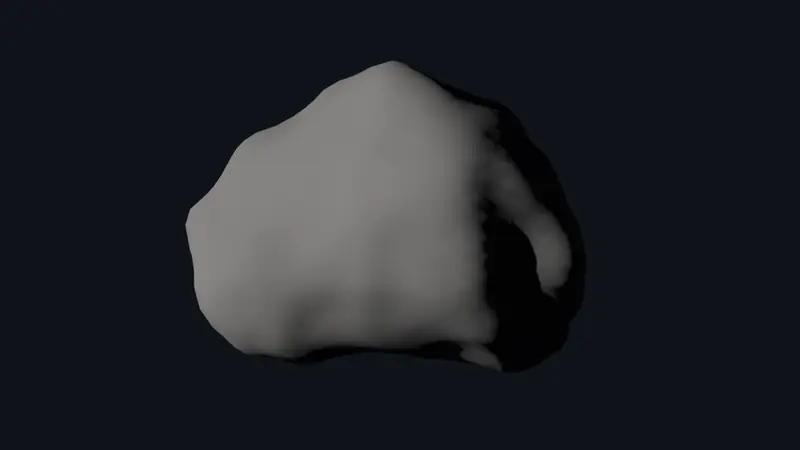
Turn a preliminary shape of asteroid Apophis, built from ground-based radar images. It shows the asteroid's overall form and size, not its boulders, and nothing about what it is made of.
The shape file is about 49 KB. Opening the 3D view also downloads viewer code. Drag to turn it. On a touch screen, use two fingers to turn and zoom and one to scroll the page.
What this shape shows, and what it does not
The shape
This is a preliminary shape model of Apophis, based on ground-based radar images from December 2012 to March 2013 reported by Brozović and others in 2018. NASA's Planetary Data System published it on 20 February 2026. Source: Radar shape model of asteroid (99942) Apophis · (99942) Apophis 3-D radar shape model, data label
The archive describes this shape as based on ground-based radar images. Bennu's and Ryugu's shapes on this site were built from data that spacecraft gathered near those asteroids. Source: Radar shape model of asteroid (99942) Apophis
Top and side refer to this model's display axes. This page does not identify north.
Measured along this model's fixed axes, its spans are about 410 × 349 × 318 m.
This copy contains 3,996 triangles, with an average edge length of about 16 m. Nothing much smaller than that can show in it, and these numbers do not establish how accurately larger features are drawn.
Missions in this dataset that name Apophis
Karman+ says its first mission, a technology demonstration, is going to Apophis. The record gives a mid-2028 launch slot and rendezvous in 2030, and the mission has not launched.
The record also notes Apophis's close approach to Earth on 13 April 2029.
After delivering its Bennu sample, NASA's OSIRIS-REx spacecraft continues as OSIRIS-APEX toward Apophis (2029).
The shape here is plain grey. Nothing on it is coloured by composition.
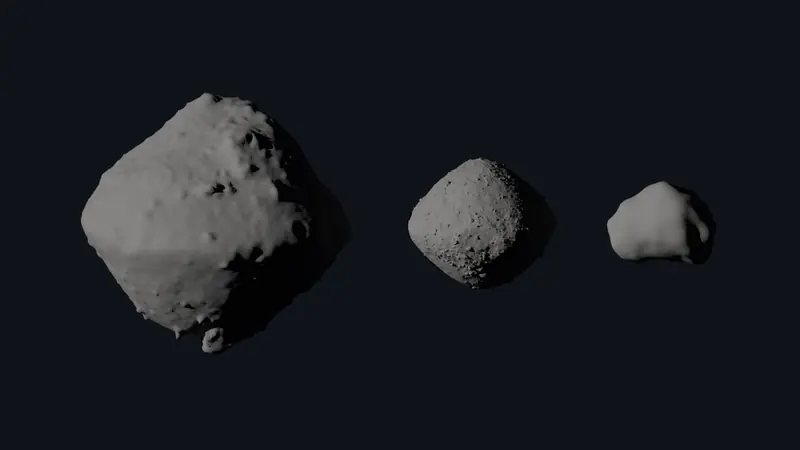
Three asteroids at one scale
Sources and credit
- Radar shape model of asteroid (99942) Apophis, NASA Planetary Data System, Small Bodies Node, 2026-02-20
- (99942) Apophis 3-D radar shape model, data label, NASA Planetary Data System, Small Bodies Node
Everything in 3D · Where the asteroids are, in 3D · Asteroid targets · Has anyone delivered a resource?