Ryugu in 3D
Turn the shape JAXA's Hayabusa2 team built from the spacecraft's camera images of asteroid Ryugu. It shows the asteroid's form and size. It does not show what Ryugu is made of.
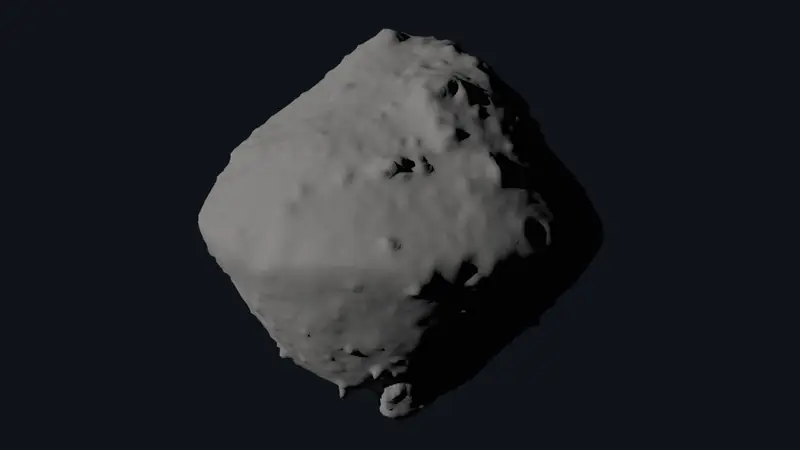
The shape file is about 0.6 MB. Opening the 3D view also downloads viewer code. Drag to turn it. On a touch screen, use two fingers to turn and zoom and one to scroll the page.
What this shape shows, and what it does not
The shape
JAXA's Hayabusa2 team built this shape from the spacecraft's camera images, using a stereo method called structure from motion. The team's archive holds a 3-million-polygon model and smaller versions of it; this is the 49,152-triangle version, from the data behind Watanabe and others' 2019 paper in Science. Source: Shape models of the asteroid Ryugu used in Watanabe et al. (2019) · Asteroid Ryugu 3D models · Initial version of the shape model for Ryugu
Top and side refer to this model's display axes. This page does not identify north.
Measured along this model's fixed axes, its spans are about 1,019 × 1,019 × 964 m.
This copy contains 49,152 triangles, with an average edge length of about 12 m. Nothing much smaller than that can show in it, and these numbers do not establish how accurately larger features are drawn.
What Hayabusa2 brought back
Hayabusa2 touched down on Ryugu on 22 February 2019 to collect surface material and again on 11 July 2019 to collect subsurface material. JAXA recovered its capsule in Australia on 6 December 2020, and JAXA's curation team gives the returned mass as 5.424 ± 0.217 g.
JAXA states that the samples contained water and organic material, and a peer-reviewed analysis reports minerals formed by water. These are laboratory science findings, not resource extraction, and no JAXA page reviewed states a resource objective for the mission.
The shape here is plain grey. Nothing on it is coloured by composition, and it does not mark where the samples were taken.
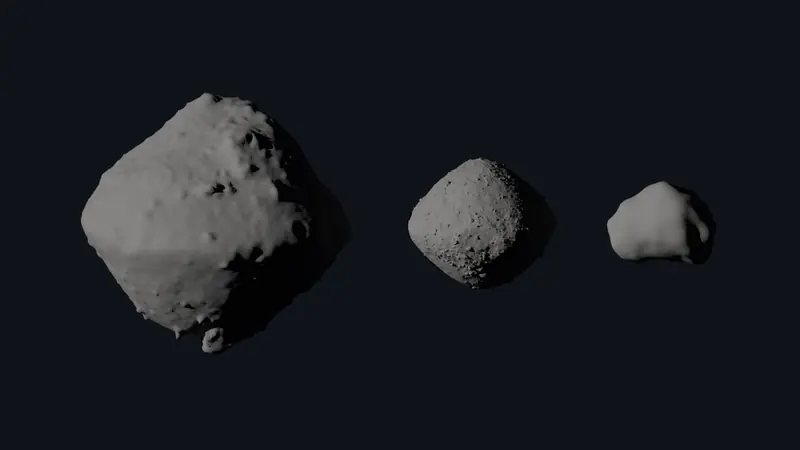
Three asteroids at one scale
Sources and credit
- Shape models of the asteroid Ryugu used in Watanabe et al. (2019), ISAS/JAXA DARTS archive
- Asteroid Ryugu 3D models, JAXA Hayabusa2 Project
- ISAS Data Policy, ISAS/JAXA, 2018-03-14
- Initial version of the shape model for Ryugu, ISAS/JAXA, 2018-07-11
Everything in 3D · Where the asteroids are, in 3D · Asteroid targets · Has anyone delivered a resource?