Bennu in 3D
Turn the shape NASA built from OSIRIS-REx's laser measurements of asteroid Bennu. It shows the asteroid's form and size. It does not show what Bennu is made of.
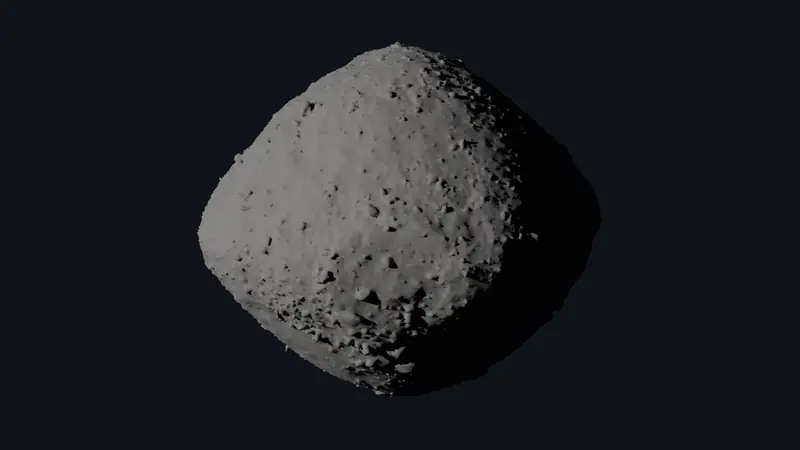
The shape file is about 1.4 MB. Opening the 3D view also downloads viewer code. Drag to turn it. On a touch screen, use two fingers to turn and zoom and one to scroll the page.
What this shape shows, and what it does not
The shape
NASA's Scientific Visualization Studio built this shape from data OSIRIS-REx collected while in orbit around Bennu. Its global model has 3.4 million polygons and was described by Daly and others in 2020. Source: Asteroid Bennu 3D Models
Top and side refer to this model's display axes. This page does not identify north or establish the asteroid's spin axis.
Measured along this model's fixed axes, its spans are about 567 × 546 × 499 m.
This copy contains 119,991 triangles, with an average edge length of about 4.3 m. The 16 m sample-site diameter is roughly 4 average edge lengths. These measurements do not establish the smallest surface features represented accurately.
Where the sample came from
NASA describes site Nightingale as a rocky area 16 m (52 ft) across in Bennu's northern hemisphere, in a relatively clear patch just above a crater's centre. Source: NASA’s OSIRIS-REx Begins its Countdown to TAG · NASA’s OSIRIS-REx Produces Nightingale Mosaic
This view does not mark the site. The official pages read for it give no coordinates, and a marker placed by eye would look more exact than it is.
The sample site before and after the touch, in 3D, from NASA's models of that ground.
What the sample showed
OSIRIS-REx delivered 121.6 grams of material from Bennu to Earth on 24 September 2023. NASA's initial analysis reported high carbon content and water-bearing clay minerals.
Those are findings about the returned material. The shape here is plain grey: nothing on it is coloured by composition, and it does not show how much carbon or water Bennu holds. This scientific sample return does not demonstrate commercial resource extraction.
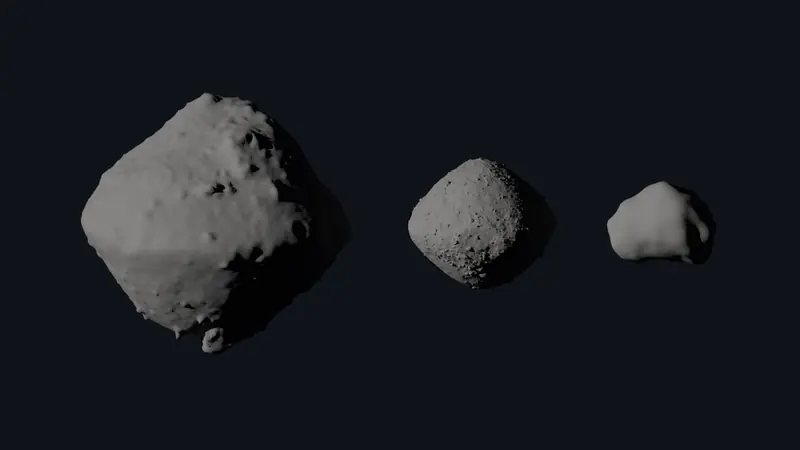
Three asteroids at one scale
Sources and credit
- Asteroid Bennu 3D Models, NASA's Scientific Visualization Studio, 2023-02-09
- NASA’s OSIRIS-REx Begins its Countdown to TAG, NASA
- NASA’s OSIRIS-REx Produces Nightingale Mosaic, NASA
- NASA Images and Media Usage Guidelines, NASA
Everything in 3D · Where the asteroids are, in 3D · Asteroid targets · Has anyone delivered a resource?